
DSD Fundamentals
Master the fundamentals of decentralised service design through 8 comprehensive activities
Workshop Creators:
Orange: Adam de Linde • Akshay Garigiparthy | Make it Clear: Arya Alatsas • Megan Cattley
Workshop Overview
What To Expect
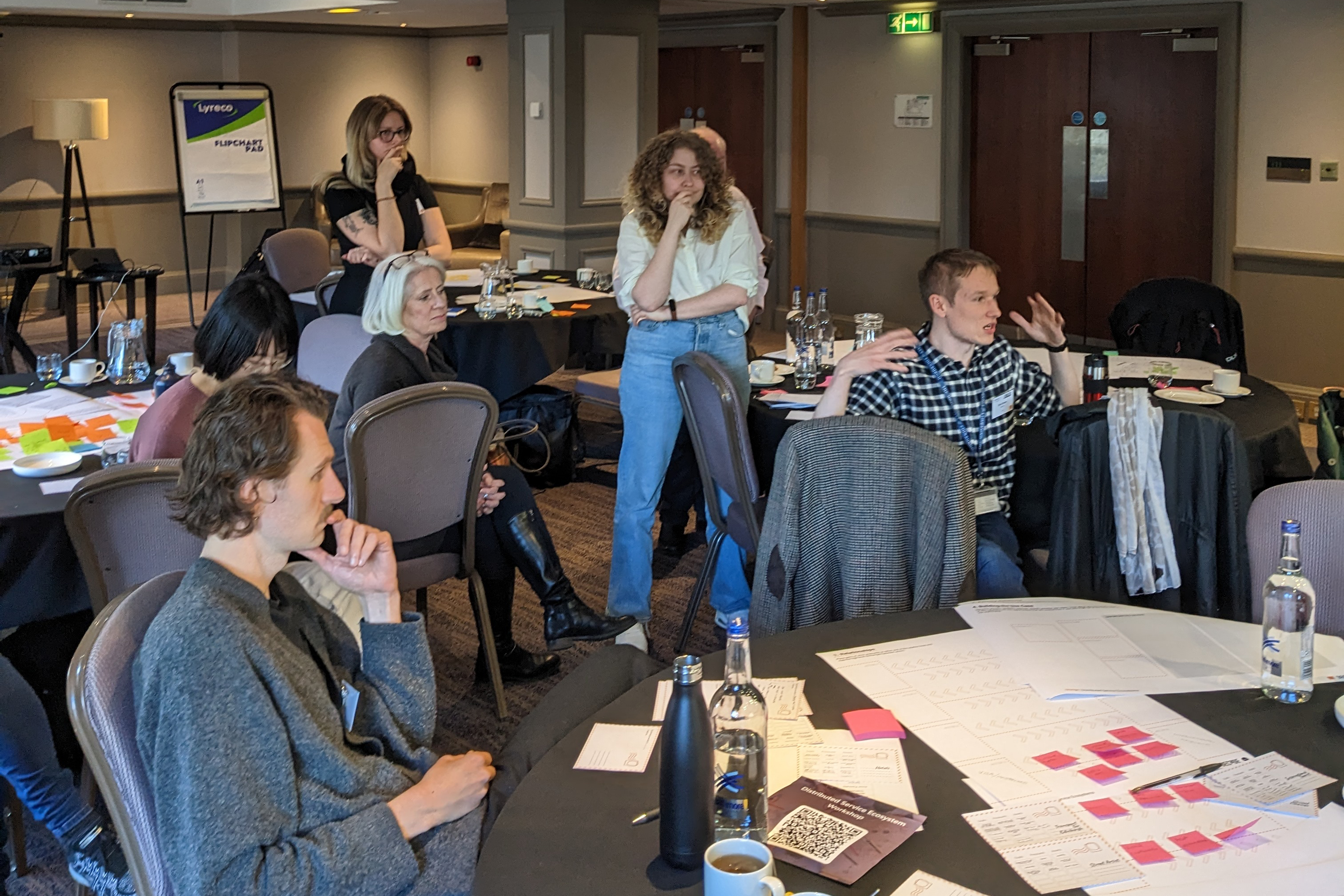
This comprehensive workshop guides you through a step by step process of designing decentralised services from the ground up. Through 8 carefully crafted activities, you'll develop a capability model and use-case that serve as the blueprint for new services in your sector.
Each activity builds on the previous one, creating a cohesive framework that explores possibilities, balances user needs and leads to a solid understanding of the unique opportunities of decentralisation.
Getting Started
To begin the workshop, download the complete materials below. You'll need the slide deck to guide your session, worksheets for participant activities, and the facilitator handbook for detailed instructions.
Preview Workshop Activities
Browse through each of the 8 activity cards below to explore what's covered in the workshop. Click on any activity to view a detailed overview of the steps, objectives, and downloadable worksheets.
At the bottom of this page, you'll also find guidance on adapting the workshop for your specific context and integrating it with other workshops in the playbook.
Activity 1: Generating a Context Statement
A context statement helps your team align on the foundational context for this workshop by clearly defining the ecosystem you want to explore, along with the challenges, opportunities, and boundaries.
Use the prompts on your worksheet to generate a high-level context statement:
- Broad Ecosystem: Identify the general domain or sector this ecosystem is serving.
- High-Level Challenges: List key obstacles or issues within this domain that we need to address. These could be, for example, existing pain points for consumers, or new legislation that requires challenging changes.
- High-Level Opportunities: Highlight promising possibilities or advantages that could help us move forward. Consider what new technologies or initiatives are on the horizon.
- Workshop Scope: Define any key conditions, constraints, or rules that will guide your discussions. Clarify what is explicitly excluded from this workshop. These could be geographic, such as "UK only", or sector specific such as "public transport only".
Example Context Statement:
"This workshop will explore the future of mobility within the UK, with a focus on all forms of land transport, excluding flights. As the country faces increasing demands for sustainable and efficient transport solutions, understanding and developing the mobility landscape is crucial."
Activity Worksheet:
Activity 2: Ideating Actors and Factors
By identifying the stakeholders (or actors) and factors involved in your business ecosystem you can begin to map how different organisation and individuals interact and influence each other.
Steps to Complete:
- Brainstorm Actors: List all human and non-human entities that participate in your ecosystem. Include organisations, individuals, software agents, autonomous devices, and any other relevant stakeholders.
- Categorise Actors: Group related actors into categories e.g., services providers, infrastructure providers and end users.
- Identify Factors: “things” that might restrict, facilitate, or otherwise influence the actors or supply chain. Think PESTLE: political, economic, social, technical, legal, and environmental factors. For example, include regulatory requirements, market conditions, competing services, technological dependencies, and social/cultural considerations.
- Map Dependencies: Note which actors and factors depend on or influence each other. Use arrows or connecting lines to show relationships.
- Prioritise: Rank actors and factors by their importance to the service's success. Focus your design efforts on the highest-priority items.
Activity Worksheet:
Activity 3: Creating Actor Portraits
It is important to understand the key actors' roles in your supply chain by identifying what they have (assets), what they struggle with (pressures), and what they aim to achieve (goals).
To do this, you will create detailed “portraits” of key actors:
- Select Key Actors: Choose 3-6 of the most important actors from your previous activity (use an additional worksheet if necessary). Focus on those that are significant in relation to your context statement.
- Assets: What are their strengths, resources, or capabilities an actor brings (e.g., expertise, infrastructure, technology).
- Pressures: What challenges, constraints, frictions or risks do they face (e.g., regulations, costs, competition).
- Goals: What outcomes do they want to achieve (e.g., growth, efficiency, sustainability) What values drive their decisions? What are they aiming for, beyond what they currently do?
Activity Worksheet:
Activity 4: Exploring Actor Relationships
Explore the relationships between the supply chain actors to understand how they interact and transact value amongst each other. Mapping these relationships will help you identify key interactions, dependencies, and potential friction points.
Within your ecosystem there may be many indirect relationships between actors. This is an opportunity to consider what the direct relationships between currently indirectly-linked actors might look like.
Steps to Complete:
- List All Interactions: For each actor pair, identify how they interact. Think of both explicit and implicit exchanges, services, and interactions between actors.
- Identify Value Flows: Value can be goods and services, as well as intangible value such as governance, regulation, and influence.
- Define Relationship Type: Categorize relationships as transactional (exchanging value), informational (sharing data), hierarchical (authority/dependency), or collaborative (working together).
- Prioritise relationships: Decide and note which relationships are the most valuable or interesting.
Relationship Mapping Tips:
- This is an exploratory activity. You're looking for both well-known and perhaps under-appreciated relationships and transactions across the ecosystem.
- Consider which direct value is flowing it, if it's flowing both ways place it on the horizonatal dotted line
Activity Worksheet:
Activity 5: Defining Capabilities
A capability is what a shared asset enables actors to do — it’s what makes an asset useful and valuable.
Assets can often have multiple capabilities. For example, a car park (asset) can store cars (capability), host events (capability), or serve as a filming location (capability).
Steps to Complete:
- Select Priority Actor: Choose an actor and asset that seem high-value or interesting.
- Describe Capability: Describe what the actor, through use of the asset, offers others in the ecosystem — this is the asset’s capabilities.
- Select Primary Capability: Identify the capability with the greatest potential value in relation to your objectives — this will be your primary capability.
- Expand Capability Details: Define this primary capability in more detail, clarifying how it creates value and for whom.
Activity Worksheet:
Activity 6: Assigning Capability Values
Determine the economic and social value of the capability to a range of actors in your ecosystem.
Steps to Complete:
- Identify Values: List the values and impacts that may be created by the capability for each actor. These could be tangible values such as a new revenue stream of data or intangible, such as trust or reputation.
- Rate Impact: Rate the value of the primary capability to different ecosystem actors, from negative to positive.
Activity Worksheet:
Activity 7: Building a Use Case
This exercise will help to identify the decentralised system in principle, outlining the asset to be leveraged, the capacity this would enable, and the benefits this may provide, to build a use case. Use cases provide concrete scenarios that guide implementation.
Steps to Complete:
- Select a Primary Scenario: Using your primary capability, identify a possible use case.
- Note: The actor providing the capability might not be directly involved in the use case transactions.
- Complete Use Case Statement: The use case definition steps will help you to complete the following statement:
Example Use Case Statement:
As a: [Actor], I own a: [Asset], Which can provide: [Primary Capability], This can benefit: [Actor], By giving them: [Opportunity], This may also involve: [Other Actor in the Relationship].
Activity Worksheet:
Activity 8: Designing a Decentralised Capability Model
In this final activity, you will explore the implications of fully decentralising a capability by examining how it shapes the relationships between different actors within a system.
You will do this by creating a visual map that highlights how this capability facilitates both positive and negative relationships between actors.
Steps to Complete:
- Prioritise capability: Choose a primary capability to focus on.
- Select Key Actors: Select five actors and position them around the edge of your diagram. Feel free to include secondary actors identified in your use cases.
- Indicate Connections: Draw connections between actors as you consider how your chosen capability affects them. Use the key to indicate the nature of each relationship (positive, neutral, or negative).
Assess the Decentralised Capability:
- A higher number of positive connections suggests that the capability may have a broadly beneficial impact and be sustainable within the wider ecosystem.
Activity Worksheet:
Make It Your Own
The DSD Fundamentals workshop is designed to be flexible and adaptable to your specific context. Whether you're working in finance, healthcare, creative industries, or any other sector, you can tailor the activities and exercises to match your unique challenges and opportunities.
Feel free to adjust the scope, focus on specific activities that are most relevant to your needs, or extend the workshop with additional exercises. For example you may have already covered the first few steps in stakeholder mapping exercises, in which case you can kick off the workshop with this information.
You can also integrate this workshop with other specialised workshops in the DSD Playbook to extend your learning journey into different aspects of decentralised service design, that are relevant to your context. Other workshops include advice on how best to do this.
The workshop materials are fully customisable—add your branding to the slides, modify the worksheets, and create new examples that fit with your context. The goal is to make these tools work for you and your team.
Share Your Experience
Have you used this workshop? We'd love to hear how it went and learn from your experience.
Get in Touch